
If you were hurt in a car accident in Atlanta or anywhere else in Georgia, the police report is one of the most important documents you’ll have. It’s the responding officer’s independent record of what happened, and insurance adjusters, defense attorneys, and even judges lean on it heavily when deciding who was at fault. The problem is that most people have never seen a Georgia crash report before, let alone tried to interpret one while also dealing with injuries, medical bills, and missed paychecks.
This guide breaks down what’s actually in a Georgia accident report, how to request a copy, and why an experienced personal injury lawyer should review it before you say a single word to an insurance company. And if requesting the report feels like one more task you don’t have the time or energy for, AG Injury Law will get it for you.
We’ll Obtain Your Police Report at No Cost to You
Recovering from a car accident is a full-time job on its own. You shouldn’t have to spend your time tracking down the right agency, paying a report fee, or waiting on hold to find out if your report is ready. That’s why AG Injury Law offers free police reports to every client we represent.
When you contact us for a free case review, our team takes on the entire process of locating and requesting your Georgia accident report and we cover the cost ourselves. You focus on healing. We focus on building your case.
Why Your Accident Report Matters for a Personal Injury Claim
Insurance companies rarely take a claimant’s word for how a wreck happened, and they will not simply accept a recorded statement over the phone. What they look for is independent documentation, and a police accident report is exactly that. It was completed by a neutral officer at or near the scene, which makes it one of the most persuasive pieces of evidence you can bring into settlement negotiations or a Georgia personal injury lawsuit.
A report that clearly places fault on the other driver can strengthen your negotiating position and move your claim toward a fair settlement faster. On the other hand, a report with vague conclusions, missing information, or factual errors can give an insurance adjuster an opening to dispute liability or push a lowball offer. This is exactly why so many injury victims bring their report straight to a personal injury attorney rather than trying to interpret it, or negotiate around it, on their own.
How to Get a Copy of a Georgia Accident Report
Georgia does not automatically mail you a copy of your report, so someone has to request it. Which agency you contact depends on who responded to your crash
- BuyCrash.com is the fastest option for most people. This online portal is used by many Georgia police departments, sheriff’s offices, and the Georgia Department of Public Safety. You will typically need your last name, the date of the crash, and either the report number, your VIN, or your driver’s license number. Reports are usually available within minutes for a small fee.
- Georgia Department of Transportation (GDOT) handles reports for crashes that occurred on state roadways and highways. Requests can be mailed in using GDOT’s request form, though this route can take a couple of weeks to process.
- Georgia Department of Public Safety (GA DPS) handles reports when the Georgia State Patrol investigated the crash. You can submit an Open Records Act request online or by mail.
- Local police or sheriff’s departments, including the Atlanta Police Department and DeKalb County Police, can also provide a copy directly if you know which agency responded to your accident. Having your ID and crash date on hand speeds up the process.
Figuring out which agency has your report, then paying and waiting for it, is exactly the kind of errand a Georgia car accident lawyer’s office is equipped to handle. At AG Injury Law, it’s one of the first things our team does after you reach out, at no cost to you.
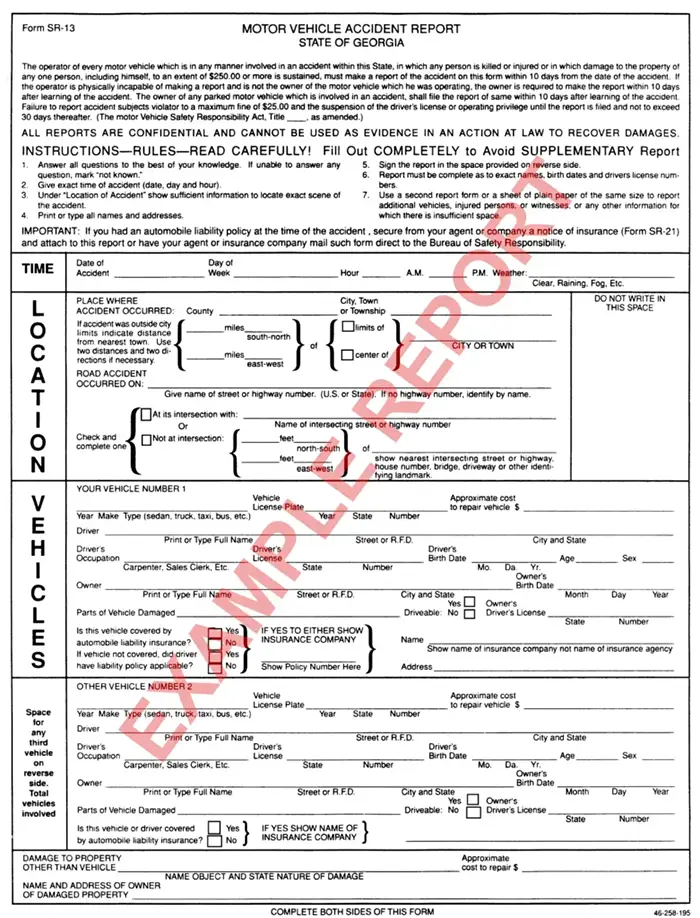
What’s Inside a Georgia Crash Report
Georgia’s standard accident report is organized into several core sections, though the exact layout can vary slightly by the investigating agency:
Crash identifiers. The report number, date, time, and location of the accident. Hold onto this number. You’ll need it for insurance calls and any conversation with your attorney.
Scene conditions. Weather, lighting, and roadway conditions at the time of the crash. These details can matter a great deal when arguing what a “reasonable” speed or following distance looked like under the circumstances.
Driver and vehicle information. Names, addresses, license numbers, insurance details, VINs, and license plate numbers for everyone involved in the accident.
A diagram of the crash. A basic sketch showing where each vehicle was positioned, the direction of travel, and the point of impact.
Contributing factors and narrative. The officer’s notes on suspected causes, such as following too closely, failure to yield, distracted driving, or speeding, along with a written summary of what the officer observed or was told at the scene.
Citations. Any tickets or charges issued as a result of the crash, which can carry real weight when establishing fault.
Every one of these sections can shape how an insurance company values your personal injury claim, which is why it’s worth having a lawyer walk through the report with you line by line rather than skimming it on your own.
Errors Are More Common Than You’d Think
Officers write these reports quickly, often while still managing an active accident scene, directing traffic, or waiting on EMS. Before you rely on your report for a claim, it’s worth checking for:
- Incorrect dates, times, or crash locations
- Wrong VINs, license plate numbers, or insurance information
- Misspelled names or bad contact information for drivers or witnesses
- A fault narrative that doesn’t line up with what actually happened
- Witness statements that are missing or don’t reflect what was actually said at the scene
If something looks off, you can request a correction directly from the agency that produced the report. Bringing supporting documentation, such as photos from the scene or witness contact information, gives your correction request a better chance of being taken seriously. An attorney who has handled hundreds of Georgia crash reports will often spot these errors faster than someone reading their first one.
Why You Shouldn’t Try to Interpret Your Report Alone
Your accident report is only one piece of building a strong personal injury claim, and it’s often the piece people feel least equipped to interpret, especially while juggling medical appointments, physical therapy, and lost income. An experienced Atlanta personal injury lawyer knows how to read between the lines of a report, identify the details an insurance adjuster might try to use against you, and push back when the narrative doesn’t match the physical evidence.
Beyond the report itself, your attorney can help you understand what your claim may actually be worth, gather medical records and additional witness statements, and manage all communication with insurance companies so you are never negotiating against a trained adjuster by yourself. At AG Injury Law, personal injury cases are handled on contingency, which means there is no upfront cost to get an experienced legal team in your corner, and you pay nothing unless we win.
Frequently Asked Questions
Do I need a lawyer to get a copy of my accident report?
No, you can request your own report through BuyCrash, GDOT, GA DPS, or the responding local agency. However, if you’ve hired AG Injury Law, we will obtain the report for you as part of your free case review, so you don’t have to spend time or money tracking it down yourself.
What if the police report says I was at fault?
A fault determination on a police report is not the final word. Officers sometimes get the narrative wrong, especially in multi-vehicle accidents or when witness accounts conflict. An attorney can gather additional evidence, such as traffic camera footage, cell phone data, or accident reconstruction, to challenge an inaccurate fault finding.
How long does it take to get a Georgia accident report?
Reports filed through BuyCrash are often available within a few minutes to a few days. Requests made directly to GDOT or through an Open Records Act request to GA DPS can take one to two weeks or longer, depending on the agency’s workload.
Does AG Injury Law really cover the cost of my police report?
Yes. When you choose AG Injury Law to represent your personal injury claim, we request and pay for your Georgia accident report on your behalf at no out-of-pocket cost to you.
Let AG Injury Law Make Sense of Your Report
You don’t have to figure out a Georgia accident report on your own, and you shouldn’t have to pay to request it either. When you contact AG Injury Law, our team will obtain your police report at no cost, walk you through exactly what it means for your claim, and help you understand your legal options from day one.
If you or someone you love was hurt in a car accident in Atlanta or anywhere in Georgia, reach out today for a free, no-obligation case review at (404) 551-2222.