
You Were Just in a Crash. What You Document in the Next Hour Could Determine Everything.
You are standing on the side of a Georgia road, adrenaline still running, trying to process what just happened. The other driver is already on their phone. Traffic is moving past. And somewhere in the back of your mind, you know you need to do something, but nobody ever told you exactly what.
Here is the truth most people learn too late. The documentation you gather in the first hour after a car accident is the single most important factor in the strength of your claim. Not what you say later. Not what the other driver admits. What exists on record right now, at the scene, before anything changes. According to the Georgia Governor’s Office of Highway Safety, Georgia records tens of thousands of serious crashes every year. The insurance adjusters who handle those claims are professionals who move fast. The better your documentation, the less room they have to reduce what you are owed.
If you have been injured in a wreck and need guidance on protecting your rights, a lawyer from our legal team is here to help. Contact us today for a free consultation at (404) 551-2222 and learn how a car accident lawyer can help you build a strong claim from the very beginning.
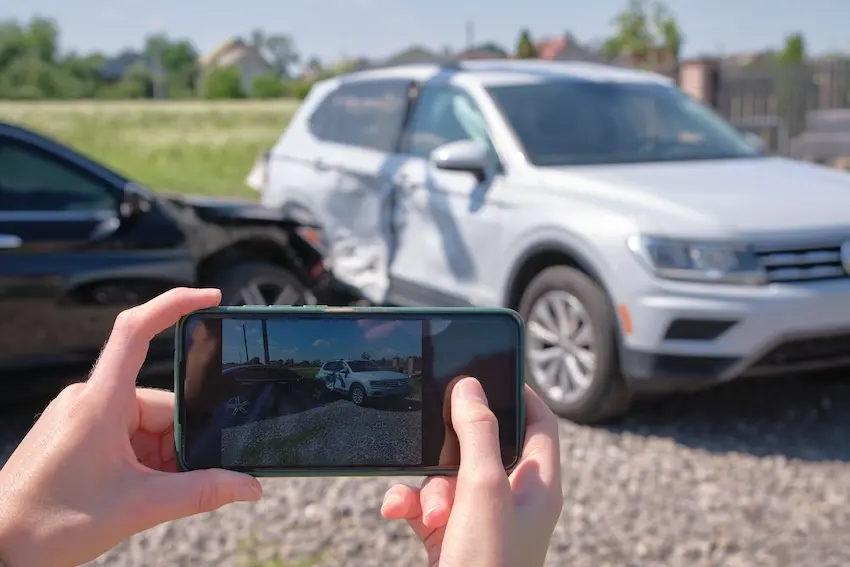
Start With the Scene Itself Before Anything Moves
The moment vehicles are moved, skid marks fade, and witnesses walk away, critical evidence disappears permanently. Your phone is the most powerful documentation tool you have. Use it immediately.
What to Photograph at the Car Accident Scene
Photograph both vehicles from every angle before they are moved. Get wide shots that show the full context of where each car ended up and close shots that capture specific damage. Photograph the road surface, skid marks, debris, and any damage to barriers, signs, or property. Take pictures of the traffic signals, lane markings, and intersection layout if relevant. Photograph the weather conditions, the lighting, and any obstructions that may have contributed to the crash.
Do not just take one or two images. Take thirty. Take sixty. Storage is free, and you cannot go back.
Capturing the Other Driver’s Information on Camera
Photograph the other driver’s license plate before you do anything else. Then, photograph their driver’s license, their insurance card, and their vehicle registration. Do not rely on writing this information down in the chaos of the scene. A clear photo of each document takes ten seconds and cannot be misread or disputed later.
If there are witnesses, photograph their contact information or ask them to write it down while you take a photo of the note. Witness accounts that are captured at the scene and tied to a real name and phone number carry significantly more weight than a witness who is vague about being there or cannot be located later.
Document the Surrounding Environment Before You Leave
Traffic Cameras and Security Footage That Could Prove What Happened
Look around the area deliberately. Identify every traffic camera, business security camera, dashcam on nearby vehicles, and residential camera within view of the crash location. Note their positions and point them out to the responding officer. Footage from these sources can be the single most powerful piece of evidence in a disputed liability case, but it disappears fast. Many systems overwrite footage within 24 to 72 hours. Your car accident lawyer needs to know about every camera at that scene as soon as possible so a preservation demand can be filed before that footage is gone.
Getting the Police Report Right
When law enforcement arrives, make sure the officer documents your account of what happened accurately. Do not minimize your symptoms or your pain at the scene, even if you feel functional. Many serious injuries, including whiplash, soft tissue damage, spinal trauma, and traumatic brain injuries, are delayed in presentation. If you tell the officer you feel fine and later discover you have a herniated disc, that statement becomes a tool the insurer uses against you.
Ask the officer for the report number before they leave so you can obtain a copy. The police report is one of the foundational documents in your claim, and the details in it matter.

Documenting Your Injuries Starts at the Scene and Continues for Weeks
Why Photographing Your Physical Injuries Immediately Matters
Photograph every visible injury at the scene and again when you reach medical care. Bruising, lacerations, swelling, and seat belt marks often appear and worsen in the hours following a crash. An injury that looks minor in the first photograph and significantly more severe in photographs taken 24 and 48 hours later tells a powerful visual story about what the crash actually did to your body.
Timestamp your photographs or use your phone’s native camera, which embeds metadata automatically. Dated and timed photographs of your injuries create a documented progression that is extremely difficult for an insurer to argue around.
Building the Medical Record That Connects Your Injuries to the Crash
Seek medical care immediately, regardless of how you feel. The gap between the crash date and your first clinical visit is one of the primary tools insurance adjusters use to argue that your injuries were not caused by the wreck. A gap of even 48 hours gives an adjuster room to build a narrative that your symptoms appeared after the fact.
At every appointment, describe your symptoms in full detail and make sure the provider documents them completely. If something hurts, tell them. If something feels different, tell them. The record created in the days following a crash is the evidence that connects what happened on that road to what you are experiencing physically, and that connection is the foundation of your entire claim. If you need guidance on how your medical documentation ties into the legal process, speaking with a car accident lawyer from the start makes that connection stronger from day one.
Keep a Daily Injury Journal From the Day of the Crash
This is the step most car accident victims skip entirely, and it is one of the most valuable things you can do for your claim.
Starting the day of the crash, write down how you feel physically every single day. Note your pain levels, where the pain is located, what activities you cannot perform, how your sleep is affected, and how your emotional state has changed. Note every appointment, every prescription, every therapy session, and every day you missed work or were unable to perform normal daily tasks.
An injury journal creates a contemporaneous record of your suffering and its impact on your life that no insurer can credibly dispute. It also captures the full human cost of what happened to you in a way that medical records alone cannot. Pain that interferes with your ability to lift your children, sleep through the night, or do your job is compensable under the law, but only if it is documented.
Frequently Asked Questions About Documenting a Car Accident in Georgia
What if I were too injured or shaken to document the scene?
This does not end your claim. A car accident lawyer can file evidence preservation demands immediately to secure camera footage and other evidence before it disappears. Seek medical care first and call a lawyer as soon as you are able so that the preservation process starts before the window closes.
How long does traffic and security camera footage last in Georgia?
Traffic cameras typically overwrite within 24 to 72 hours. Business security systems vary from 30 to 90 days, depending on storage capacity. Once a car accident lawyer serves a preservation demand, the recording party is legally obligated to retain the footage. Without one, it disappears on its normal schedule with no legal obligation to save it.
Can my injury journal be used as evidence in a car accident claim?
Yes, and it is often one of the most persuasive pieces of evidence available. A daily journal documenting your pain levels, physical limitations, missed work, and emotional impact creates a contemporaneous record that medical files alone rarely capture. Your car accident lawyer uses that documentation to pursue pain and suffering, loss of enjoyment, and emotional distress as compensable damages under the law.
What if the other driver disputes my account of what happened?
Physical proof tells the story independent of what either driver says. Skid marks, damage patterns, camera footage, and witness accounts establish the accurate liability picture before the insurer builds a narrative around the other driver’s version. Georgia’s modified comparative fault rules make this critical since any fault assigned to you reduces your recovery. A car accident lawyer who knows how to use forensic evidence to counter a disputed liability argument is your strongest protection here.
Do I need a lawyer to handle the documentation process?
You can and should gather photos and seek medical care immediately on your own. But filing evidence preservation demands, ensuring your medical records capture the right detail, and preventing the insurer from exploiting gaps in your documentation all require legal experience that most people do not have. The sooner a car accident lawyer is involved, the stronger your documentation foundation will be from the start.

A Lawyer From AG Injury Law Is Built to Fight for What Your Documentation Proves
Gathering the right documentation after a car accident is critical. Knowing what to do with it is where a lawyer from AG Injury Law steps in.
A lawyer from our team moves immediately to file evidence preservation demands, secure camera footage before it disappears, and build the legal foundation that makes your claim impossible for an insurer to dismiss. We handle every communication with the insurance company from the moment you call, and we fight for the full and fair compensation Georgia law entitles you to recover.
AG Injury Law is a member of the Georgia Trial Lawyers Association and the National Trial Lawyers Top 100. We hold a perfect 5.0 Google rating across 79 reviews. No fees unless we win. Free case review available 24/7.
Tell us what happened, and we will respond immediately. Contact us today to get started or learn more about AG Injury Law and how we work before you decide.
Call AG Injury Law at (404) 551-2222. Serious injuries. Serious results.