
You Are Still Shaking. The Other Driver Is Already on Their Phone. What You Do in the Next 24 Hours Changes Everything About Your Recovery.
You are sitting in a damaged car on a Georgia highway, hands trembling, mind racing, trying to process what just happened while traffic streams past and the other driver is already on their phone. The next 24 hours will determine more about the outcome of your injury claim than any other period in the entire process. According to the Georgia Governor’s Office of Highway Safety, Georgia records more than 385,000 car accidents every year. The insurance adjusters who handle those claims are professionals who move fast. The decisions you make today either protect your recovery or hand them the tools to reduce it. Having an Atlanta car accident lawyer involved from the start changes that equation entirely.
Here is exactly what to do, in order, starting right now.

Step 1: Do Not Leave the Scene
Georgia law requires you to remain at the scene of any accident involving injury, death, or property damage. Leaving before law enforcement arrives is not just legally problematic, it hands the other driver’s insurer a narrative they will use against you immediately. Stay at the scene. Move your vehicle to the shoulder if it is safe to do so and your vehicle is operable. Activate your hazard lights. Do not move anyone who may be seriously injured unless they are in immediate danger from fire or oncoming traffic.
Step 2: Call 911 Immediately
Do not rely on the other driver’s promise to handle things privately. Do not accept their suggestion that a police report is unnecessary for a minor crash. Call 911 and request both law enforcement and emergency medical services regardless of how you feel physically. A police report creates an official record of the crash, documents the scene before anything changes, and establishes a factual foundation your attorney will use to build your claim. In Georgia, under O.C.G.A. § 40-6-273, accidents resulting in injury or death must be reported to law enforcement immediately. Do not give the other side any reason to question whether the crash was serious enough to warrant documentation. It was.
Step 3: Document Everything at the Scene
While you are waiting for law enforcement to arrive, use your phone to document everything you can. Photograph both vehicles from multiple angles before they are moved. Photograph the road surface, skid marks, traffic signals, lane markings, and any debris. Photograph the other driver’s license plate, insurance card, and driver’s license. Get the names and contact information of every witness present. If there are traffic cameras, business cameras, or residential cameras visible from the scene, note their locations. That footage can disappear within 24 to 72 hours if a preservation request is not filed quickly. Your car accident lawyer needs to know about it as soon as possible so a preservation demand can be filed before that footage disappears.

Step 4: Do Not Apologize and Do Not Explain
This is one of the most consequential decisions you will make at the scene and most people get it wrong without realizing it. Do not say sorry. Do not say you did not see them coming. Do not speculate about what happened or why. Do not tell the other driver, the witnesses, or the responding officers anything beyond the basic facts of what occurred.
Why an Apology at the Scene Can Cost You Thousands
An apology at the scene is not just an expression of sympathy. In the hands of an experienced insurance adjuster, it becomes a recorded admission of fault. The adjuster does not need you to say the words “I was at fault.” They need you to say anything that implies awareness of your own role in the crash. “I am so sorry, I did not see you” is enough. That statement gets documented in the adjuster’s notes, referenced in the insurer’s liability assessment, and potentially used in litigation to argue that you acknowledged responsibility at the scene. An apology you offered out of basic human decency can end up costing you thousands of dollars. Stick to the facts, let the evidence tell the story, and let your car accident lawyer do the talking from that point forward.
What Not to Post on Social Media After a Car Accident
Reaching for your phone to tell people what happened feels natural. Do not do it yet. Insurance adjusters routinely monitor claimants’ social media accounts after a crash, looking for anything that contradicts your injury claim. A photo, a check-in, a tag from a friend, even a comment saying you are feeling better can be pulled and used to reduce what you are owed. Set your accounts to private immediately, say nothing about the accident or your injuries online, and ask friends and family not to post about it either. One careless post can cost you significantly more than you realize and your car accident lawyer will tell you the same thing the moment you call.
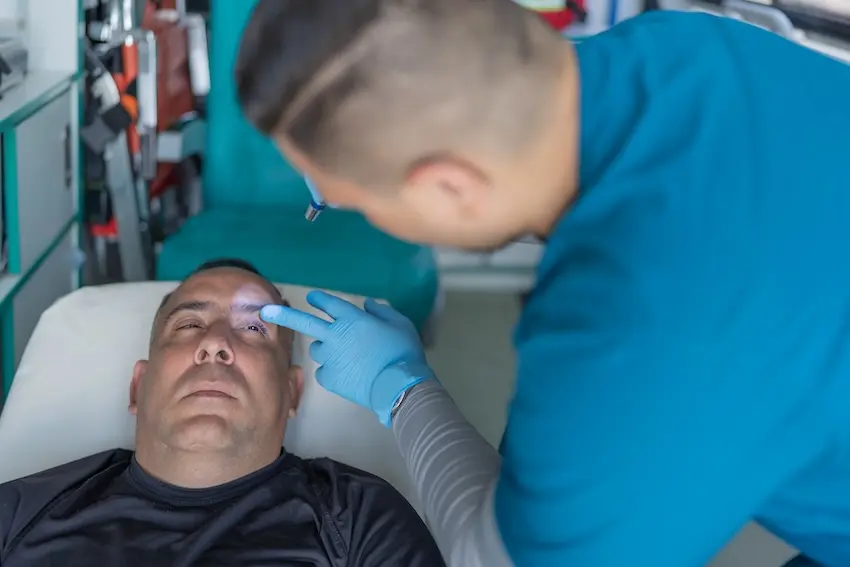
Step 5: Seek Medical Care Immediately Even If You Feel Fine
This step carries more legal weight than almost any other decision you make in the first 24 hours, and every car accident lawyer will tell you it is the one most people skip. Do not skip it.
Car accident injuries, particularly whiplash, soft tissue damage, spinal trauma, and traumatic brain injuries, are notorious for delayed presentation. You can feel completely functional at the scene and wake up the next morning unable to move your neck. You can feel slightly sore and discover three days later that you have a herniated disc. The adrenaline and shock of a crash mask pain and impairment in ways that can persist for hours.
Why the Gap Between the Crash and Your First Medical Visit Matters
Seeking immediate medical care does two things simultaneously. It protects your health by identifying injuries before they worsen. And it creates the medical documentation that connects your injuries directly to the crash. Georgia insurers specifically look for the gap between the crash date and the first medical visit. A gap of even 24 to 48 hours gives an adjuster room to argue that your injuries appeared after the fact rather than as a result of the crash. That argument costs claimants significant money every single day in Georgia. Do not give them that opening.
Step 6: Do Not Talk to the Other Driver’s Insurance Company
The other driver’s insurer will call you. They will be polite. They will sound reasonable. They will tell you they just need a quick statement to process the claim. Do not give it to them.
Insurance adjusters are trained professionals whose job is to pay as little as possible on every claim. A recorded statement taken in the first 24 hours after a crash, while you are still in pain, still processing what happened, and still unaware of the full extent of your injuries, is one of the most powerful tools they have to reduce what you are owed. You are under no legal obligation to give a recorded statement to the other driver’s insurer. Politely decline.
What to Say to Your Own Insurance Company
Most people know not to give a recorded statement to the other driver’s insurer. Fewer realize the same caution applies to their own. Your policy almost certainly contains a cooperation clause requiring you to assist in any claim investigation, and that obligation is real. But cooperation does not mean giving an unguarded recorded statement before you have spoken with an attorney. Your own insurer has a financial interest in minimizing what they pay out and that interest does not always align with yours. Contact an Atlanta car accident lawyer before giving any recorded statement to any insurer including your own and let your attorney handle communications from the start.
What If the Other Driver Has No Insurance
Georgia has one of the highest rates of uninsured drivers in the country so this situation is more common than most people expect. If the at-fault driver cannot produce valid insurance at the scene your recovery options are not exhausted. Georgia law requires insurers to offer uninsured and underinsured motorist coverage on every auto policy sold in the state. If you carry either on your own policy your insurer steps in to cover the gap.
In certain circumstances Georgia law also allows those policies to stack, meaning multiple policies may apply to your claim simultaneously. An uninsured at-fault driver makes your claim more complex, not impossible. Call an Atlanta car accident lawyer before you assume you have no options.
What If You Were a Passenger
Passengers are in a legally distinct position that most car accident resources never address. As a passenger, you bear no fault for the crash regardless of which driver caused it, meaning you have potential claims against the at-fault driver, the driver of the vehicle you were in, or both simultaneously, depending on how fault is allocated. If either driver is uninsured, your claim may extend to additional coverage sources depending on the policies involved.
Passenger injury claims are more complex than standard driver versus driver claims, and identifying every available source of recovery requires an attorney who knows where to look. If you were injured as a passenger, call an Atlanta car accident lawyer before assuming your only option is the at-fault driver’s policy.

Step 7: Call an Atlanta Car Accident Lawyer Before the Day Is Out
Steps 5 and 6 are significantly more effective when an attorney is handling them from the start. The reason you can decline that recorded statement without consequence is because your attorney takes over every communication with the insurer the moment you call. The reason your medical documentation is strongest when it starts immediately is because your car accident lawyer helps you build it correctly from day one rather than trying to reconstruct it later.
The first 24 hours are when evidence is freshest, when witnesses remember most clearly, when camera footage still exists, and when the other side has had the least amount of time to build their narrative. An Atlanta car accident lawyer who gets involved on day one protects everything that matters before it disappears.
AG Injury Law’s car accident lawyers are available 24 hours a day, 7 days a week. We handle every communication with the insurance company from the moment you call. We file evidence preservation demands immediately. We connect you with the medical documentation process that protects your claim. And we do all of it with no upfront cost and no fees unless we win.
The first 24 hours set the trajectory of your entire claim. Do not spend them navigating this alone.
AG Injury Law Is Ready to Help Right Now
If you were in a car accident today, yesterday, or recently and you have not yet spoken with an attorney, the time to call is now. Every hour that passes without legal representation is an hour the other side uses to build their case against yours.
AG Injury Law has recovered millions for Georgia accident victims including $750,000 for an auto accident client and $1,500,000 on a single case. We are a member of the Georgia Trial Lawyers Association and the National Trial Lawyers Top 100. We hold a perfect 5.0 Google rating across 79 reviews. No fees unless we win. Free case review available 24/7.
Contact us today to get started or learn more about AG Injury Law and how we work before you decide.
Call AG Injury Law at (404) 551-2222. Serious injuries. Serious results.